


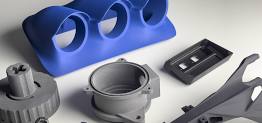
Mar 12, 2026
"How much will my 3D print cost?" is the first question almost every customer asks, and the honest answer is: it depends. But that does not mean pricing is unpredictable. Once you understand the five factors that drive cost, you can estimate whether a part will be 5 euros or 500 euros — and make smart design decisions that keep the price where you want it.
This guide explains exactly how 3D printing is priced, what to expect for each technology, and how to reduce costs without sacrificing the quality your project needs.
The Five Factors That Determine Cost
Every 3D printing quote comes down to five variables. Understanding these gives you control over the price before you even submit your file.
1. Technology
The technology you choose has the biggest impact on cost. Each uses different equipment, materials, and post-processing requirements.
FDM (Fused Deposition Modelling) is the most affordable option. The machines are efficient, material costs are low, and parts can be printed quickly. FDM is the default choice for most prototyping and functional part applications.
SLS (Selective Laser Sintering) costs more per part because the equipment is more expensive to operate and the nylon powder material costs more than FDM filament. However, SLS becomes very cost-effective in batches because multiple parts can be packed tightly into a single build — the powder acts as its own support, so there is no wasted support material and no post-removal labour.
SLA (Stereolithography) falls in the mid-to-high range. Resin materials cost more, parts require post-curing in a UV chamber, and support structures need to be removed and surfaces cleaned up. The trade-off is significantly higher detail and surface quality.
2. Material
Within each technology, material choice affects price. Engineering-grade materials cost more than standard ones.
FDM material costs (relative):
MaterialRelative costBest for PLA LowestConcept models, non-functional prototypes PETG LowFunctional parts, chemical resistance ABS Low-MediumAutomotive, electronics, heat resistance ASA MediumOutdoor parts, UV resistance Nylon PA Medium-HighMechanical parts, gears, wear resistance TPU Flexible MediumGaskets, grips, flexible components
SLS:
Nylon PA 12 is the standard SLS material. It costs more than FDM plastics per kilogram, but because SLS builds are packed efficiently and unfused powder is recycled, the effective material cost per part can be surprisingly competitive — especially for batches.
SLA:
Standard Resin is moderately priced. Tough Resin and specialty biocompatible resins for dental and medical applications cost more, reflecting the tighter material certification and quality requirements.
3. Part Volume and Size
This is the most intuitive factor — bigger parts cost more because they use more material and take longer to print. But volume and size are not the same thing.
A hollow box that is 200 mm on each side uses far less material than a solid block the same size. The material consumed depends on the actual volume of solid material in the part — wall thickness, infill percentage, and internal structure all matter.
How to reduce volume (and cost):
- Reduce infill — For prototypes, 20% infill is usually sufficient. Going from 100% to 20% infill can cut material cost by 60% or more.
- Shell the part — If your design is currently solid, consider hollowing it out with a uniform wall thickness. A 2 mm shell with 20% infill is strong enough for most applications.
- Remove unnecessary mass — Fillets, chamfers, and thin features add volume that you might not need for the part's function.
4. Build Time (Machine Hours)
3D printers cost money to run — electricity, maintenance, technician oversight, and machine amortisation. Parts that take longer to print cost more.
What increases build time:
- Height — A part that is 150 mm tall takes three times as many layers as a 50 mm part, regardless of its footprint. Orientating your part to minimise height can significantly reduce print time.
- Fine layer heights — Printing at 0.1 mm layers produces smoother surfaces but takes twice as long as 0.2 mm layers. If surface finish is not critical, standard layers save time and money.
- Support structures — For FDM and SLA, support material adds to both print time and post-processing labour. Designing parts to minimise supports (see our FDM design guidelines) directly reduces cost.
5. Post-Processing
The raw part off the printer is rarely the finished product. Post-processing adds cost but is often essential.
Standard post-processing (usually included):
- Removal of support structures (FDM, SLA)
- Depowdering and bead blasting (SLS)
- UV post-curing (SLA)
- Basic cleanup and quality inspection
Optional post-processing (additional cost):
- Sanding and smoothing
- Painting or dyeing
- Vapour smoothing (for SLS nylon parts)
- Heat-set brass inserts for threaded connections
- Assembly of multi-part builds
For architecture and scale models, post-processing often represents a significant portion of the total cost because presentation quality demands sanding, priming, and painting. For engineering parts that go straight into a machine, post-processing is minimal.
Realistic Cost Ranges by Technology
These ranges are based on typical orders we see from customers across Europe. Your specific part will vary, but this gives you a ballpark before you request a quote.
FDM Pricing
Part typeTypical cost rangeExampleSmall concept model (fits in hand)€5 – €25Phone case prototype, small bracketMedium functional part€15 – €80Custom jig, electronics enclosure, mounting plateLarge structural part€50 – €250Equipment housing, drone frame, architectural elementMulti-part assembly€100 – €500+Complete product prototype, robotic gripper set
SLS Pricing
Part typeTypical cost rangeExampleSmall functional part€15 – €50Gear, clip, connector, hingeMedium mechanical part€40 – €150Spare valve housing, tooling aid, end-of-arm toolBatch of 10 identical parts€100 – €400Production run of clips, brackets, housingsBatch of 50+ parts€5 – €25 per partSmall production series, digital inventory
Notice how SLS pricing scales favourably in batches. This is because the entire build chamber is run once regardless of how many parts are packed inside. Ten parts often cost only marginally more than three parts in the same build.
SLA Pricing
Part typeTypical cost rangeExampleSmall detailed part€10 – €40Jewelry master, dental model, miniatureVisual prototype€30 – €120Product housing, presentation modelDental aligner mould€3 – €8 per unitBatch pricing for production volumesArchitecture model (with finishing)€200 – €2,000+Competition or presentation model with paint
How 3D Printing Compares to Traditional Manufacturing
Understanding where 3D printing wins on cost — and where it does not — helps you choose the right manufacturing method for your project.
3D Printing Wins When:
Quantity is low (1 to 500 parts). There is no tooling to amortise. Your first part costs the same as your hundredth part. CNC machining requires programming and fixturing setup. Injection moulding requires a mould that costs €3,000 to €50,000+. With 3D printing, you pay only for what you print.
Geometry is complex. Internal channels, lattice structures, organic shapes, and thin-walled complex forms are either impossible or extremely expensive to CNC machine. 3D printing handles them at no additional cost — complexity is essentially free.
Speed matters. A CNC-machined custom part might take 2 to 4 weeks. A 3D printed version can ship in 3 to 5 days — or 24 hours with express service. For product design teams iterating weekly, this speed advantage has real dollar value.
Design changes are frequent. Every design revision in CNC or injection moulding means reprogramming or retooling. In 3D printing, you upload a new file and print. The cost per iteration is just the cost of the part.
3D Printing Loses When:
Quantity is high (1,000+ parts). At production volumes, injection moulding's per-part cost drops well below any 3D printing technology. The break-even point depends on part complexity, but for simple parts it can be as low as 200 to 500 units.
Material requirements are specific. If you need a specific metal alloy, glass-filled engineering polymer, or certified aerospace material, traditional manufacturing may be your only option. 3D printing materials are improving rapidly but do not yet cover every specification.
Tolerances are extremely tight. If you need ± 0.05 mm or better, CNC machining is still the way to go. FDM achieves ± 0.3 mm, SLS ± 0.2 mm, and SLA ± 0.1 mm.
Seven Ways to Reduce Your 3D Printing Costs
- Choose the right technology. Do not use SLA when FDM will do. If your part does not need a mirror-smooth surface, FDM will get you there at a fraction of the cost.
- Reduce part height. Reorient your design so the shortest dimension faces upward. Fewer layers means less print time and lower cost.
- Lower the infill. For non-structural parts, 20% infill is usually enough. Ask for lower infill when you request your quote.
- Hollow out solid parts. A 2 mm shell with infill is almost always sufficient. Solid prints use the maximum material and take the longest to print.
- Design to avoid supports. Follow the FDM design guidelines — keep overhangs under 45 degrees, use chamfers instead of fillets on bottom edges, and consider splitting complex parts.
- Batch your orders. If you have multiple parts to print, submit them together. Especially for SLS, batching parts into one build is significantly cheaper than printing them individually across separate orders.
- Choose standard materials. PLA and PETG are the most affordable FDM materials. Only upgrade to Nylon or specialty materials if your application genuinely requires their properties.
Getting an Accurate Quote
Every part is different, which is why we quote each project individually rather than listing fixed prices. Our quoting process is fast and free:
- Upload your file — STEP, STL, OBJ, 3MF, or IGES format. STEP is preferred for the most accurate quoting.
- Tell us about the application — What does the part need to do? Any specific material or finish requirements? How many do you need?
- We review and recommend — Our team checks your file for printability, recommends the best technology and material, and sends you a detailed quote — typically within a few hours on business days.
- No obligation — Getting a quote is free and there is never any pressure. We quote hundreds of parts per month that never become orders, and that is fine.
Request your free quote now or contact us if you want to discuss your project before submitting files. We are happy to give ballpark estimates over email or phone to help you plan your budget.
Frequently Asked Questions
Is there a minimum order?No. We print single parts, and there is no minimum order value. Whether you need one prototype or fifty production parts, we treat every order the same.
Do you charge for file review?No. We check every file for printability before quoting and will flag any issues — overhanging features, thin walls, non-manifold geometry — at no charge.
Can I get a quote without a CAD file?For rough estimates, yes — describe your part size, material preference, and quantity and we can give a ballpark. For an accurate quote, we need a 3D file.
What payment methods do you accept?We accept bank transfer, credit card, and invoicing for business customers. Standard payment terms are available for repeat customers.
Do you offer volume discounts?Yes. Repeat customers and larger batch orders receive preferential pricing. Get in touch to discuss ongoing requirements and we will set up a tailored pricing structure.


Mar 11, 2026
Compare environmental impacts of 3D printing and injection molding across material waste, energy consumption, local production, and recyclability for sustainable manufacturing.


Mar 11, 2026
Choosing the right file format is essential for successful 3D printing. Learn when to use STEP, STL, OBJ, 3MF, and IGES formats to optimize your prints and ensure compatibility.
.webp)




Copyright © 3D On Demand